When operators or engineers ask me to help specify a new cooling tower, the counterflow versus crossflow question comes up almost every time. It is one of the foundational decisions in tower selection, and it has real consequences for performance, maintenance, footprint, and operating cost over the life of the installation. Neither configuration is universally superior — the right choice depends on the specific application, site constraints, and operating priorities.
The Geometry
The difference between the two configurations is simply the relationship between water flow and air flow through the fill section.
In a counterflow tower, water falls vertically downward through the fill while air flows vertically upward — counter to the direction of the water. This creates the most thermodynamically favorable arrangement: the coldest water (at the bottom, just before it exits to the basin) is in contact with the coolest incoming air (entering at the bottom of the fill), while the hottest water (entering at the top of the fill) is in contact with the most saturated, warmest exiting air. This progressive temperature approach is what makes counterflow the more thermally efficient configuration per unit of fill volume.
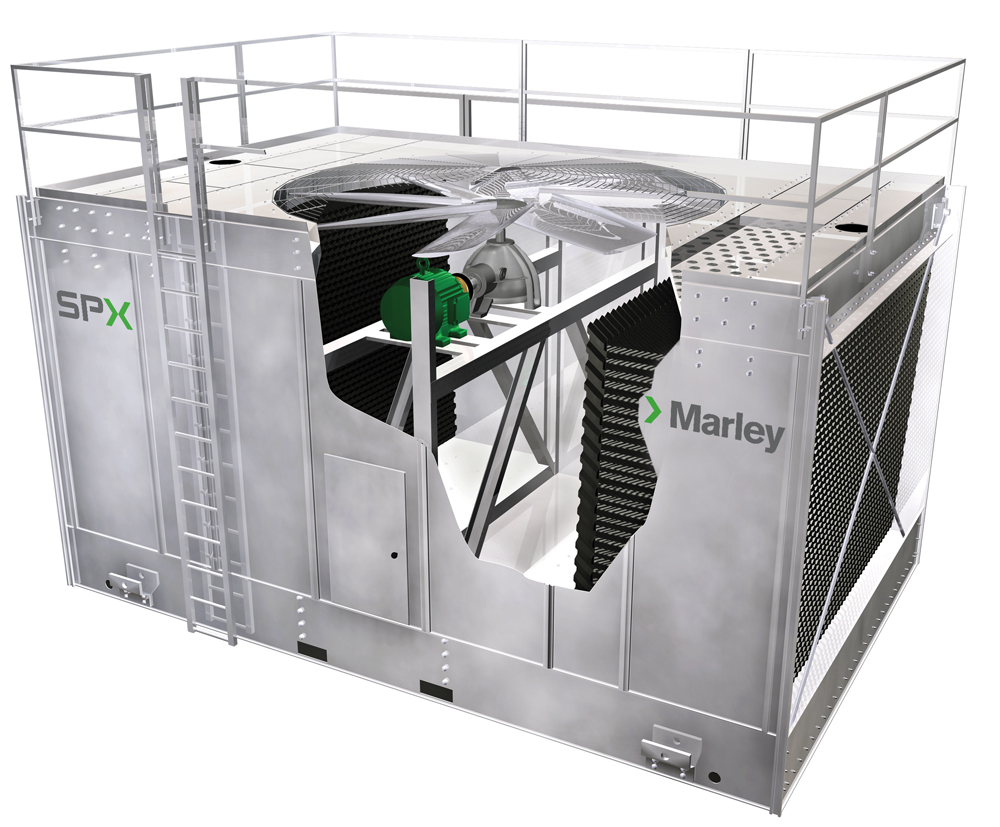
In a crossflow tower, water falls vertically downward through the fill while air flows horizontally through it — perpendicular to the water. The air enters through louvers on the sides of the tower and exits through the top. This arrangement gives up some of the thermodynamic efficiency of counterflow but offers significant practical advantages in terms of fill access, internal height, and water distribution.
Thermal Performance
Counterflow towers generally achieve a given cooling duty in a smaller footprint than crossflow towers because the thermodynamic arrangement allows more efficient use of fill volume. If space is constrained and the application demands close approach temperatures — meaning the cold water temperature must approach the ambient wet-bulb temperature closely — counterflow is typically the better choice.
That said, the efficiency difference is not dramatic in most real-world conditions, and crossflow towers can be sized to meet the same duty as a counterflow tower of comparable tonnage. Modern crossflow designs from EVAPCO, BAC, and Marley have closed much of the historical efficiency gap through improved fill geometry and distribution system design.
Maintenance Access
This is where crossflow towers have a consistent practical advantage. In a crossflow design, the fill sections are accessible from outside the tower — panels can typically be removed from the side to reach the fill for inspection, cleaning, or replacement without entering the tower or disassembling major components. The water distribution system in a crossflow tower is a gravity basin at the top of the fill, which can be inspected and cleaned from above.
Counterflow fill sits beneath the water distribution system, inside the tower. Accessing it typically requires entering the tower and working in a confined, wet environment. The pressurized spray nozzles used for water distribution in counterflow towers require more careful maintenance than the gravity basins of crossflow designs — nozzle clogging is a frequent service issue that reduces distribution uniformity and thermal performance.
For operators who perform maintenance with their own staff rather than contracting it, the difference in maintenance accessibility is a real consideration. A tower that is easier to maintain gets maintained more regularly.
Footprint and Height
Counterflow towers tend to be taller relative to their footprint — the vertical fill arrangement requires sufficient height for water to fall through the fill and for air to travel up through it. Crossflow towers tend to be lower profile and wider, which can be advantageous on sites with height restrictions or where visual impact is a concern.
In retrofit situations, where a tower is replacing an existing unit and must fit within the structural envelope of a cooling tower support structure, the dimensional constraints of the existing installation often drive the configuration choice more than any thermodynamic consideration.
Operating in Venezuelan Conditions
In the Venezuelan context, where many cooling tower installations operate in warm, humid coastal or industrial climates with varying maintenance resources and sometimes inconsistent water treatment programs, I generally favor crossflow configurations for new installations unless there is a specific reason to choose otherwise. The easier fill access, the gravity distribution basins that are simpler to inspect and clean, and the more tolerant operating characteristics under sub-optimal maintenance conditions are practical advantages that matter over the life of the installation.
When thermal efficiency or footprint constraints drive the selection toward counterflow, the choice is entirely supportable — but it should come with a commitment to the more demanding maintenance program that counterflow designs require to deliver their efficiency advantage consistently over time.
Both Configurations, Well Maintained
The gap between a well-maintained counterflow tower and a neglected counterflow tower is larger than the gap between counterflow and crossflow at their best. Configuration matters, but it matters less than a consistent maintenance program, good water treatment, and prompt attention to problems as they develop. The best cooling tower is the one that is sized correctly for the application and operated and maintained properly over its service life.