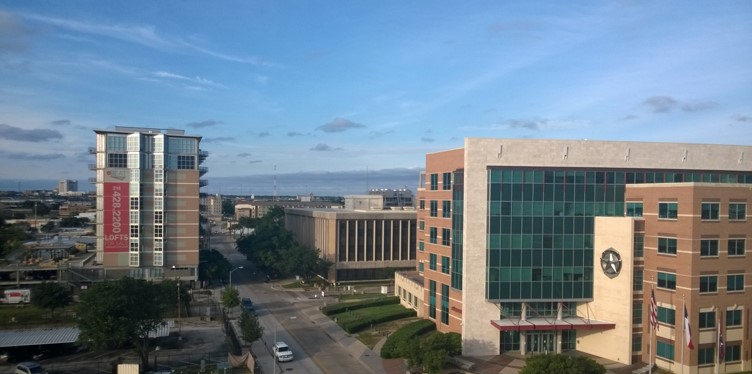
Yesterday I visited the rooftop at Nylo Hotel in Dallas, Texas. It was a clear evening with a view of the downtown skyline, favorable weather, and an infinity pool — the kind of setting where most people look at the city lights. I looked at the cooling towers.
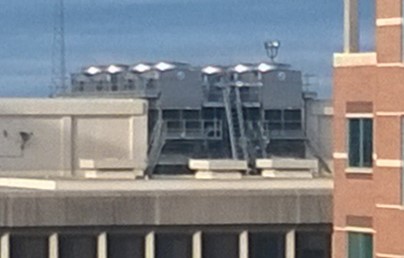
On a building visible from the rooftop, I spotted an eight-cell cooling tower installation. It wasn't prominently displayed or labeled — it sat on the building in the way that mechanical equipment always does, occupying its corner of the roofline with no interest in being noticed. But eight cells is a significant installation, and it immediately prompted the question: what is this building?
Redundancy and Variable Load Management
After a quick investigation, it turned out the building houses a data center. This made the multi-cell configuration immediately sensible. Data centers have two strong reasons to favor many smaller cells over a single large unit.
The first is redundancy. A data center cannot afford its cooling to fail. With eight cells, any single cell can be taken offline for maintenance or repair while the remaining seven continue to meet the thermal load. A single large tower would require a planned shutdown or a costly parallel standby unit to achieve the same resilience.
The second is variable load management. Data centers don't run at constant load — traffic fluctuates by time of day, day of week, and seasonal variation in ambient conditions. Eight individually controllable cells allow fine-grained capacity modulation: bring cells online as load increases, take them offline as it drops. This is both operationally efficient and energy-efficient, since you're only running what you need rather than cycling a single large tower between full and minimum speed.
Quiet Work
What struck me most was how quietly the installation operated. Eight cells running simultaneously, moving enormous volumes of air to reject the heat from thousands of servers — and from the rooftop of Nylo Hotel, the entire installation was essentially inaudible against the ambient noise of the city. That's good engineering: the noise was designed out, or at least managed to the point where it doesn't intrude on the surrounding environment.
As the evening went on and the rooftop filled with more people, I returned to my table. Another day in wonderful Texas — and another reminder of the work that goes on quietly, overhead, while everyone else enjoys the view.