Water, unless in a pure, distilled form, holds a certain percentage of dissolved solids — minerals, salts, and other compounds picked up from the source and from the systems it passes through. In an open evaporative cooling system, this presents a fundamental challenge: when water evaporates, only the vapor escapes to the atmosphere. The dissolved solids stay behind.
Over time, in the absence of effective water treatment, the concentration of dissolved solids in the circulating water increases continuously. Eventually, those solids begin to precipitate out of solution and deposit on equipment surfaces as scale — visible as the brownish, hard mineral coating familiar to anyone who has opened a cooling tower basin or inspected a heat exchanger tube bundle.
How Scale Affects Performance
Scale is not merely an aesthetic problem. It directly degrades the thermal performance of evaporative cooling equipment. In film fill towers, scale deposits block the narrow flow channels in the fill media, reducing the wetted surface area available for heat transfer. In evaporative condensers and closed circuit coolers, scale on heat transfer coils acts as an insulating layer, increasing the temperature difference required to transfer a given amount of heat — which means the process runs hotter for the same amount of cooling.
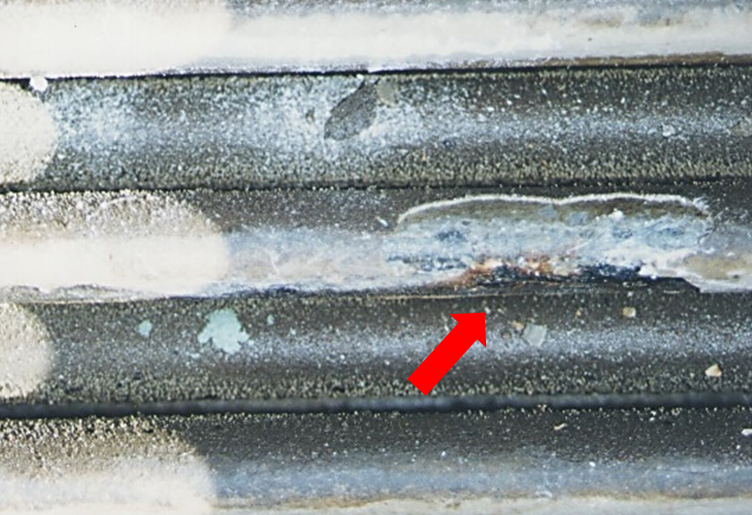
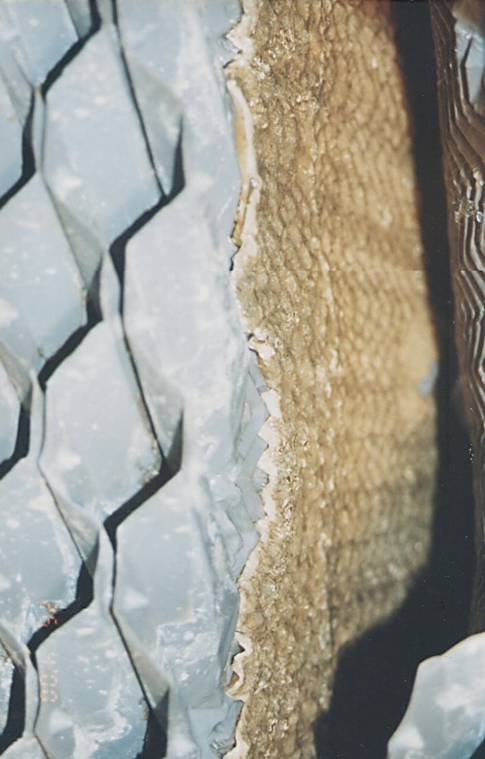
Beyond reduced efficiency, scale conceals and accelerates corrosion damage. The area beneath a scale deposit is frequently an oxygen-depleted, chemically aggressive microenvironment — exactly the conditions that favor localized corrosion attack on metal surfaces. What appears externally to be intact metal covered in scale may be severely pitted or thinned beneath the deposit. Scale also adds physical weight to fill media and other components, potentially causing structural failure over time in heavily fouled installations.
Preventive Management
The most effective approach to scale is prevention. Several strategies exist:
- Bleed-off (blowdown): Continuously or periodically releasing a portion of the circulating water and replacing it with fresh make-up water limits the concentration of dissolved solids. The bleed rate is set to maintain the concentration cycles within an acceptable range.
- Chemical treatment: Scale inhibitors interrupt the crystallization process, keeping dissolved minerals in solution rather than allowing them to precipitate. This requires a water treatment program with ongoing chemical dosing and monitoring.
- Reverse osmosis: Treating the make-up water supply with reverse osmosis before it enters the system reduces the dissolved solids loading from the start. Higher capital cost but highly effective.
- Magnetic treatment: Devices that apply a magnetic field to the circulating water to alter the crystallization characteristics of dissolved minerals. Results are mixed and contested in the literature, but some operators report positive experience.
Corrective Treatment
Once scale has formed, the approach depends on severity. In early stages, scale is relatively soft and responds to chemical cleaning — acid-based descalers applied to the affected surfaces can dissolve the deposit without mechanical intervention. This is the most cost-effective removal approach and the one that causes the least risk of collateral damage.
Thick, long-established scale deposits are another matter. At sufficient thickness, chemical treatment alone becomes impractical — the acid may not penetrate to the substrate, or the volume of chemical required becomes prohibitive. At this stage, mechanical removal is unavoidable: hand tools, scrapers, and high-pressure hydro-jets to physically break up and remove the deposit. This is labor-intensive and time-consuming, and aggressive removal techniques on heavily fouled fill often result in physical damage to the media.
Some operators, facing fill that has been destroyed by combined scale and mechanical removal attempts, choose to retrofit the tower from film fill to splash fill. Splash fill is less thermally efficient per unit volume, but it is far more tolerant of scale — the splash-type configuration doesn't depend on narrow channels that can be blocked. Additional cells or additional capacity must be added to compensate for the reduced efficiency, but the ongoing maintenance burden is significantly reduced.
The practical lesson from years of dealing with scale is consistent: early intervention is always easier and cheaper than late intervention. The brownish deposits you see forming in the basin after six months of operation are incomparably easier to address than the hard, thick, pitted scale present after years of neglect.